A guide to voting in Berlin for first-time voters
With the allowance of dual citizenship starting in the summer of 2024 and Berlin’s modernization of the application process for naturalization, the ranks of new voters in Berlin are swelling like never before. I myself was naturalized in January 2025 and was lucky enough to immediately get to put my new democratic rights into practice in the federal and state elections that happened in February 2025.
The next Berlin elections are coming up on September 20th 2026, meaning there are presumably thousands of Berliners who will be voting for the first time this year. But as exciting as this prospect can be, it's also intimidating: in our home countries, we have decades of experience with how politics and elections work to fall back on, and we know exactly where to go to inform ourselves about issues on the ballot or what stances various candidates have. But when you haven’t grown up in the German political system, you don’t have this intuition to fall back on – you have to build it from the ground up, which can seem especially daunting if your language skills are still a work in progress.
So in the vein of my previous explainer for government and administrative bodies in Berlin, I've prepared an overview here of resources and information that will hopefully help first-time Berlin voters orient themselves and make informed choices. This is not meant to be an authoritative list of everything you have to know, but rather, an entry point into the German (specifically Berlin) system, with some helpful links to further resources.
Note: This post does not go into detail on political parties in Germany / Berlin, nor does it cover what the different political organs are for which you can cast a vote – for more on the latter, see my older post “A gentle introduction to government structures in Berlin”, also mentioned above. For insight into political parties, check out the Bundeszentrale für politische Bildung, among other resources (also mentioned at the end of this post).
I am now a German citizen and there is an upcoming election – what do I need to do to make sure I can vote in September?
Best case (and most likely scenario): you don’t need to do anything to be able to vote in the upcoming election. By having a registered address in a city (and being noted in the city registry as a German citizen), you are automatically registered to vote.
Several weeks before the election, all eligible voters will receive a Wahlbenachrichtigung (Election Notice) from their local Wahlamt (Elections Office). The Wahlbenachrichtigung is effectively what verifies that you are registered to vote, and you’ll need to bring it with you to your polling location when you go to vote. (For 2026, these notices have already started going out and by the time this gets published, I would expect most voters to have already received their Wahlbenachrichtigung).
Each Berliner Bezirk has their own Wahlamt which manages the process of sending out these letters. They use the central registry of Berlin residents (i.e. the Melderegister) to know who should receive a Wahlbenachrichtigung and where to send it to. As long as you’re registered at the correct address, you don’t need to do anything. That said, if an election is drawing near and you haven't received the Wahlbenachrichtigung (according to the Website for the Landeswahlleiter in Berlin, you should receive this document by August 31, 2026), contact the Wahlamt for your Bezirk, and they will help you sort it out (to find this contact info, just a do an internet search for your Bezirk + Wahlamt, and you should find the relevant website containing an e-mail and/or phone number).
If your naturalization is happening very close to the upcoming elections – and thus you may not receive your Wahlbenachrichtigung in time for the election – you should contact your Wahlamt to see what they advise you to do. The most important thing is that you apply for your German Personalausweis as soon as possible, as that is what updates your status in the Melderegister as now being German and thus eligible to vote.
Where do I go to vote?
You will be assigned a polling location (“Wahllokal”) in your area. This location will be communicated to you in your Wahlbenachrichtigung. Generally speaking, you cannot go somewhere else to vote, unless for example you have a physical disability and your assigned location is not accessible. In that case, you should either apply to vote absentee (“Briefwahl”) or apply for a Wahlschein to cast your vote in a different polling location.
You can view a list of all polling locations (including notes on how accessible the location is) here.
I can’t make it to my polling location on election day. Can I vote absentee? How?
You can! And even better: in Berlin, you can apply for your absentee ballot – in German this is called “Briefwahl” – completely online. This is the government service (Dienstleistung) you need to access for it – instructions for accessing and filling out the form are there: https://service.berlin.de/dienstleistung/349992/
Note: the form is only available in a specific time frame before the election – if you are checking it a few months before the election and are confused that there is no link to the mentioned online form, this is a feature, not a bug. But I can speak from personal experience that applying for this is very easy, as I had to do it in 2025 and I was shocked how unbureaucratic it was.
You can find more information on how Briefwahl works here.
Are there voting districts in Berlin? How can I see where they’re located and what they look like?
Berlin is divided into 78 different Wahlkreise, i.e. electoral districts that have direct, elected representation in the Abgeordnetenhaus. The total number of Wahlkreise is set per law, but the decision as to how these 78 electoral districts are spread across the Bezirke is made by the Berlin Senate in advance of each election. The primary factor for deciding this distribution is population – each Wahlkreis should have roughly the same number of German citizens living in it. You can find an overview of the Wahlkreise for the 2026 election here.
Each Wahlkreis is in turn divided into so-called Wahlbezirke. These are purely administrative in function (i.e., they don’t represent constituencies that elect a representative). Each Wahlbezirk corresponds to a Wahllokal, i.e. polling location, and all Wahlbezirke should also have roughly the same amount of eligible voters living in them . So the division of Wahlkreise into Wahlbezirke is a way to ensure that polling locations are evenly spread throughout the city.
How do I know what’s going to be on the ballot for the next election?
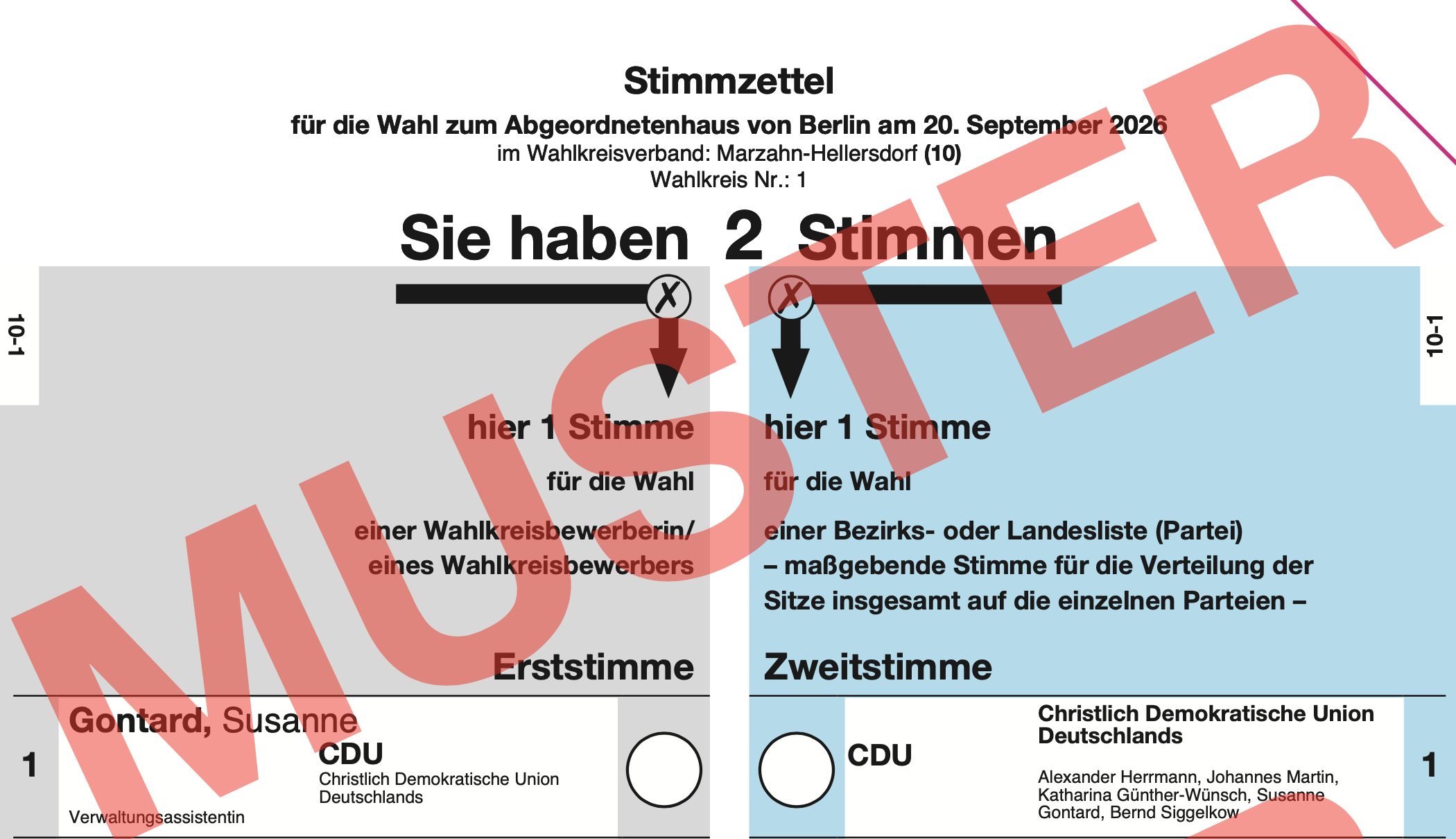
The website for the Landeswahlleiter publishes a “Musterstimmzettel” (sample ballot) several weeks before the election. The ballots for the 2026 Berlin election are available here. There is one PDF file per each Bezirk, and within the files there is a different sample ballot for each electoral district (Wahlkreis). To find out what your Wahlkreis is so you can find the correct ballot for your district, you can use this tool from the Abgeordnetenhaus.
Generally speaking, for Berlin elections there will always be three main votes to be cast. Two of those votes are relevant for the Abgeordnetenhaus, Berlin’s state parliament: these are the Erststimme (First Vote), which is a vote cast for a direct representative for your respective Wahlkreis; and the Zweitstimme (Second Vote), which is a vote for a political party – additional seats in the Abgeordnetenhaus will be allocated to the various parties proportionate to the amounts of votes they receive via Zweitstimmen. The third vote is for the Bezirksverordnetenversammlung (BVV) of your respective Bezirk – this is effectively a district-level parliament. There are no direct representatives elected to the BVVs – citizens (including EU citizens, who are allowed to vote in district-level elections) cast a vote for a party, and seats are allocated to parties proportionate to the votes received.
In some election years there will be further measures on the ballot like “Volksentscheide”, which are direct referenda that citizens can decide on (like the referendum “Deutsche Wohnen enteignen” from 2021, in which citizens voted to expropriate large housing agencies). You’ll tend to hear about movements like that months in advance, as organizers first need to secure a minimum number of signatures from eligible voters in the city and they will thus spend weeks or months canvassing across the city to acquire signatures.
Where can I learn who my current representatives are?
To learn who is currently directly representing your district in the Berlin Abgeordnetenhaus, you can visit this page from the Abgeordnetenhaus. If you provide your address, they will tell you who your current representative is and provide biographical information on them as well as links for how to contact them.
To learn who is representing you on the federal level, you can use this tool from the Bundestag, which will tell you who your representative is based on your postal code.
How can I learn more about individual candidates (e.g. background, stances, voting history, etc.)?
As far as I am aware, the best resource for this is the independent, non-profit website Abgeordnetenwatch. There you can see information about individual elected officials, including their voting records and memberships in parliamentary committees. Abgeordnetenwatch also allows visitors to submit questions directly to elected officials; the answers are posted for all to see.
Where can I see results from previous elections?
If you’re looking for data to better understand how different parties have fared in previous elections, there are a few resources I would highlight:
The Berliner Landeswahlleiter and the Amt für Statistik Berlin-Brandenburg jointly run the website “Berliner Wahlergebnisse”, which offers tables and visualizations (as well as links to raw data) of the most recent elections.
The Amt für Statistik Berlin-Brandenburg also offers its own homepage with some additional historical data to explore.
Additionally, Berlin newspapers will typically post their own results analyses after elections, including city-wide maps showing how different parts of the city voted (for federal elections they also do country-wide maps). On this page you can find their analysis of the most recent federal election; in the map tabs you can browse historical data as well. Here is their page for the last Berlin election, which also allows for exploring historical data.
Where can I see current polling results and other predictions for the upcoming election?
In general: don’t expect flashy visualizations of horse-race polling the way news outlets tend to do it in the US – election polling just isn’t the same beast out here (and maybe that’s not a bad thing). Here are a few of the resources I personally would highlight (in addition to polling coverage from reputable news outlets like Tagesspiegel or Morgenpost).
Wahlrecht.de is sort of the OG online aggregator of poll results. The website is very old school and not the easiest to navigate or nicest to look at, but it fulfills its basic purpose of communicating the latest polling data.
Also not winning any awards for aesthetics but still communicating a lot of valuable information is the website Dawum.de. Their Berlin page, for example, offers several different helpful visuals, including an overview of all the different possible governing coalitions based on current predictions for seat allocations in parliament.
Lastly, I’d like to shout out Zweitstimme.org, which is run in part by an old professor of mine (hi, Simon!). Unlike the other resources mentioned, Zweitstimme isn’t just reporting polling data but is instead tries to build an actual prediction model that uses various data points beyond just polling data. They present confidence intervals for their predictions and explore the statistical likelihood of different political scenarios.
Where can I learn more about politics and elections in Berlin and Germany?
Here are a few relevant pages:
I have linked many subpages from the homepage for the Landeswahlleiter for Berlin – this is the central administrative organ that manages elections in Berlin, and they put out a variety of helpful resources in advance of elections and also publish official data on the results of elections.
A very good, non-Berlin-specific resource is the Bundeszentrale für Politische Bildung. They have a ton of articles on topics spanning the German political system, historical events and international politics. They are a politically neutral and trustworthy organization. They are also the official home of the beloved Wahl-O-Mat, which is a tool that allows you to rate different political statements with respect to how strongly you agree or disagree with them, and then it suggests to you which political party most closely aligns with your political beliefs.
Final note: a special thanks to my dear friend Niklas for always being at the ready any time I have a random question about how German government and politics works. I’ve learned from the best.